
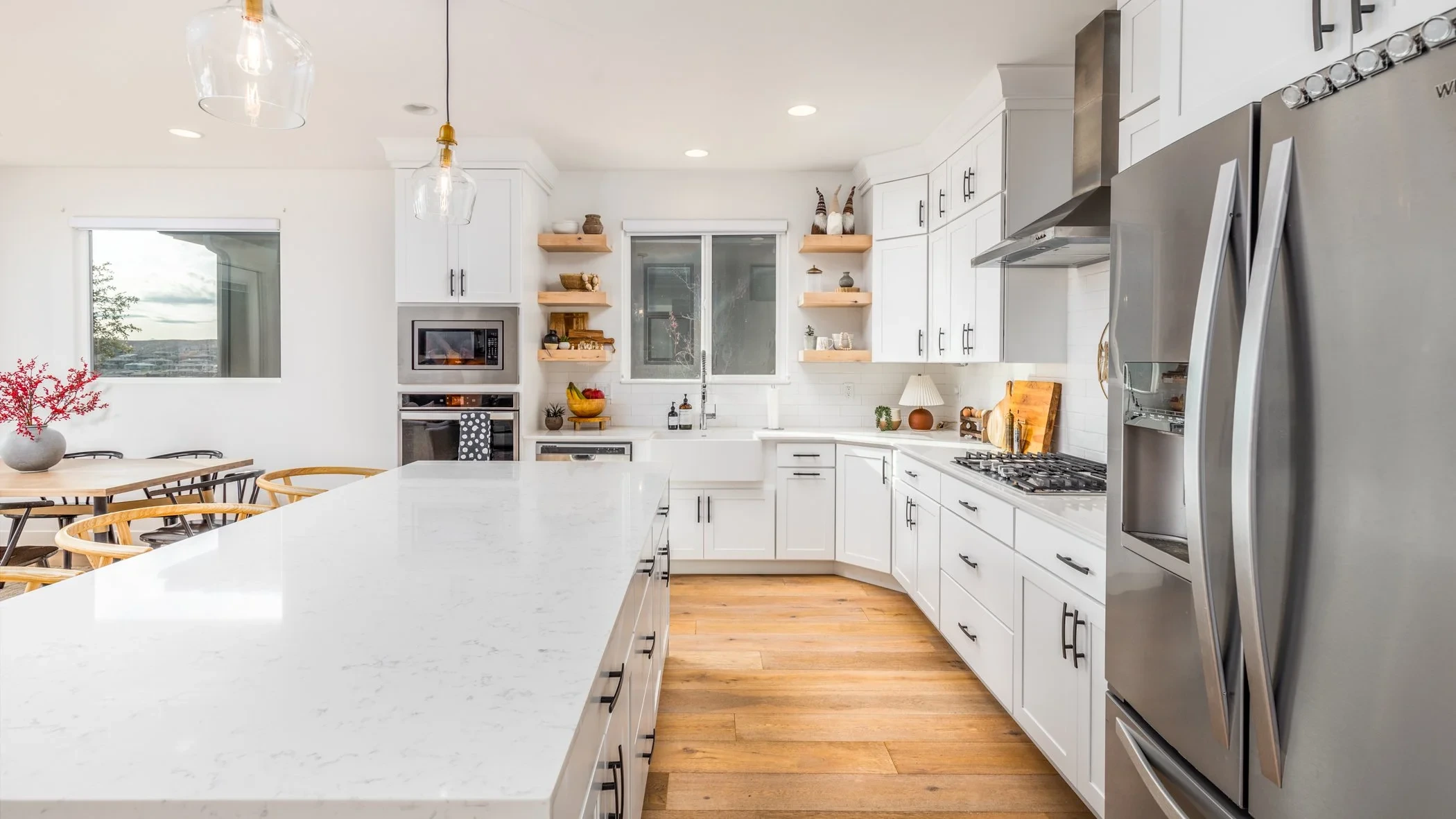
An empty room is a difficult subject because so much of the frame can be floor, wall and ceiling. Asking for the widest possible photograph may include more of the room, but it does not turn that photograph into a measurement.
The useful objective is to explain the room’s shape and connections without asking one image to prove its dimensions.
Why the near corner can dominate
A wide field of view can include nearby features and a distant wall in the same frame. Their apparent sizes depend on the viewpoint and their distances from the camera. Canon’s perspective explanation illustrates how strongly foreground and background can be separated in wide-angle compositions. That is a visual relationship, not a floor-area calculation.
Changing the viewpoint changes the relationship. Cropping a photograph does not supply the dimensions that were never recorded as measurements in the first place.
Three review questions that are better than “Can it look bigger?”
- Can I locate the important openings? A view that shows the entry and a window may explain more than another angle containing mostly blank wall.
- Does the foreground overwhelm the room? If a nearby edge dominates, ask whether another composition could explain the space more clearly. Do not prescribe a lens setting without considering the room.
- What question remains unanswered? A second view should explain a connection or feature, not simply repeat the first image from the other corner.
What straightening does—and does not—tell you
Camera tilt can make parallel architectural lines appear to converge. Adobe’s perspective-correction example shows how editing can change that presentation and affect the edges of the frame. Straight-looking walls still do not certify room dimensions or replace a measured plan.
Keep the image review and the property-fact review separate. If a buyer needs to know whether a particular bed or table fits, provide verified dimensions through the appropriate listing information rather than suggesting they estimate from a photograph.
The vacant-room brief
Try: “Please show the doorway, window and connection to the hall. There is no furniture in the room. We want viewers to understand the space, not an exaggerated sense of scale.” That gives the photograph a job it can actually perform.
For Sam’s property photography, the aim is a useful representation of the real space. More room in the frame is valuable when it adds understanding—not simply because it makes a larger-looking rectangle.
A practical check before sending the gallery
Imagine a buyer asks whether a dining table will fit beside the kitchen island. Use the photographs to show where the dining area sits and how it connects to the kitchen. Check the actual available width, table dimensions and circulation space separately; the apparent gap in a wide photograph is not a reliable ruler. If the room’s measurements have not been verified, say so rather than estimating from cabinet doors, tiles or furniture in the frame.
Before sharing the gallery, pair each room’s useful overview with any genuinely informative second angle. Keep verified dimensions in the property information, and flag any missing connection view for review.
Contact Sam with the property location and the rooms or connections you want the photographs to explain.
From Sam Reed’s property photography portfolio; editorial illustration, not a Same-Day HDR sample or a case study of this article.