
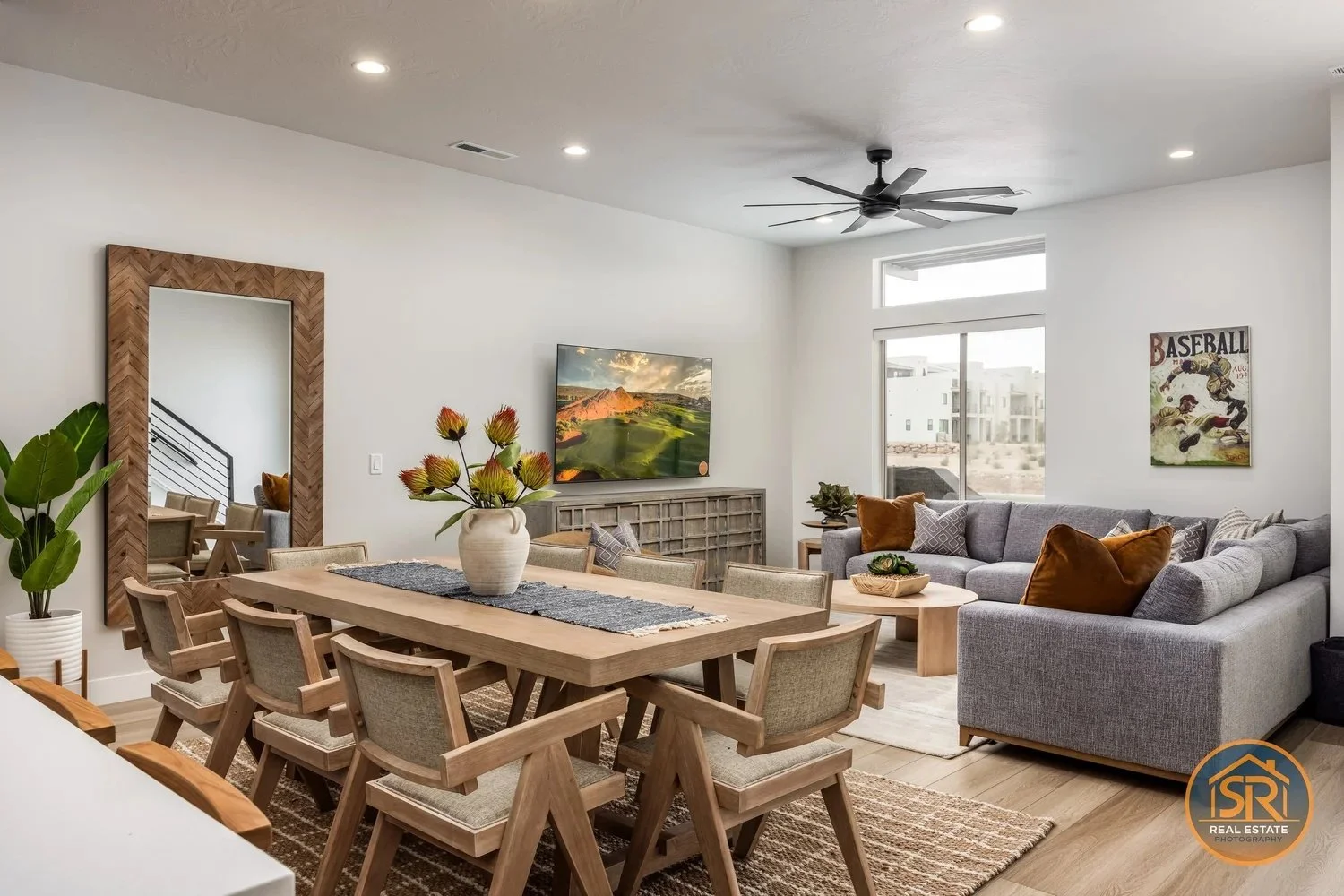
From Sam Reed’s property photography portfolio; editorial illustration, not a Same-Day HDR sample or a case study of this article.
“St George real estate photography luxury home best realtor” is not a useful description of a kitchen. It is a string of search terms. If that is all a person receives instead of the image, they learn almost nothing about the space.
Where your website or publishing tool provides an alt-text field, use it to communicate the image’s purpose. The W3C’s Images Tutorial distinguishes informative photographs from decorative and functional images: the appropriate alternative depends on what the image does in that context.
Three practical rewrites
Weak: Kitchen photo.
More useful: White kitchen with a central island, wood stools and silver-finish appliances.
Reason: Names visible elements rather than repeating the image type.
Weak: Beautiful luxury outdoor living.
More useful: Covered patio with seating beside glass doors.
Reason: Describes the space without an unsupported quality label.
Weak: IMG_7421.
More useful: Dining table beside an open living area with a sofa.
Reason: Explains the relationship a filename cannot communicate.
These examples are descriptions, not assertions about material specifications, room dimensions or property location. Write your final version while looking at the actual image. Do not copy a description onto a different photograph just because both are kitchens.
Alt text is not the same as a caption
A visible caption can carry context such as “From Sam Reed’s portfolio; editorial illustration.” The alt text can describe the room. Avoid making a reader hear the same long sentence twice when the surrounding text already supplies it.
W3C’s writing tips favor concise, purpose-focused alternatives and generally discourage unnecessary openings such as “picture of.” A useful test is to read the page without showing the photograph: what essential information would the reader be missing?
When the image is a link
If the photograph itself acts as a link or button, the alternative may need to explain that function rather than merely list objects in the scene. W3C’s tutorial treats this as a different case. Check how the image is used on the page before pasting in a room description.
A purely decorative image that conveys no necessary information and has no link or button function can use an empty alternative, alt="", as the W3C tutorial explains. Do not add a description merely to fill the field.
Describe what this particular angle adds
For the portfolio photograph accompanying this article, the connection between the dining table and living area is more useful than a list of every chair, cushion and decorative object. A concise description such as “Connected dining and living areas with a sofa, dining table, and open circulation” communicates that relationship.
If a second photograph shows the same room from another angle, consider what new information it contributes. Perhaps it makes the patio doors or the kitchen connection clearer. Describe that useful difference rather than pasting the same sentence onto every photograph. This is an application of W3C’s purpose-and-context guidance, not a requirement to invent a unique description for every file.
Stay with what you can verify. A photograph may show a light-colored countertop, but it does not necessarily establish the material, brand or age. The same restraint applies to room dimensions and claims about accessibility. Put confirmed property specifications in the listing copy rather than guessing from the image.
A quick publishing habit
Open the selected image at a useful size.
Name the room or subject and the most relevant visible relationship.
Remove sales adjectives, redundant city names and details you cannot verify.
Check whether nearby text already gives the same information.
Preview the published page to confirm the intended image and description were saved.
Good alt text does not need to sound like advertising. Its job is to make the visual information available, accurately and economically.
Planning new images for a listing? Explore Sam Reed’s property photography services or get in touch to discuss the spaces you need to show.
